Small Wind Turbine Charge Controllers: Dump Loads, Braking and Battery Protection
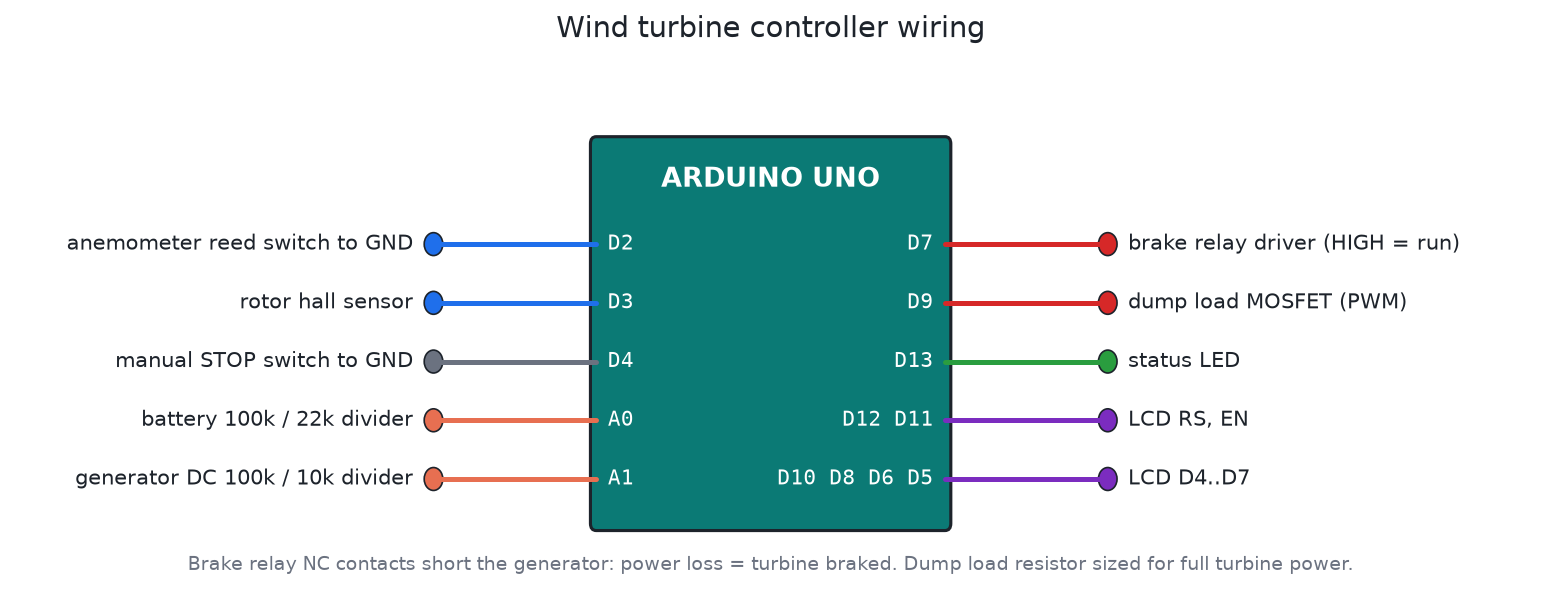
On windy ridges far from the grid, a small wind turbine charging a battery bank can power lights, phones and a few appliances. The turbine itself is the easy part. What decides whether it survives its first storm is the controller.
A solar charge controller can simply disconnect the panels when the battery is full. A wind turbine controller cannot do that. This post explains why and what a wind controller does instead.
Why you must not just disconnect a wind turbine
A solar panel with nothing connected to it sits quietly at its open-circuit voltage. A wind turbine with nothing connected to it has no electrical load slowing the rotor. In strong wind it speeds up until something gives: blades flex into the tower, bearings overheat, and the open-circuit voltage climbs high enough to damage electronics.
The turbine must always have a load. When the battery is full, that load is a dump load, also called a diversion load.
How diversion control works
- While the battery is below its charging setpoint, all the turbine's power goes into charging.
- As the battery voltage reaches the setpoint, the controller starts switching power into a resistive dump load, usually with PWM through a MOSFET. It diverts just enough to hold the battery at the right voltage.
- In strong wind with a full battery, nearly all the power goes into the dump load, which turns it into heat.
Because the turbine never sees an open circuit, the rotor stays loaded and its speed stays under control.
Charging setpoints for a 12 V lead-acid battery
Typical values (check your battery's datasheet, and scale by 2 or 4 for 24 V or 48 V banks):
| Stage | Voltage | Purpose |
|---|---|---|
| Absorption | about 14.4 V | Bring the battery to full charge |
| Float | about 13.6 to 13.8 V | Hold it full without gassing |
| Low-voltage disconnect | about 11.5 V | Disconnect loads before deep discharge damage |
Lead-acid setpoints should also be temperature-compensated, about −0.024 V per °C for a 12 V battery, because batteries in cold mountain huts need a higher charging voltage and hot ones a lower one. Lithium batteries need different setpoints and their own battery management system.
Sizing the dump load
The dump load must be able to absorb the turbine's full output continuously, plus a margin for gusts. A common rule is 1.25 to 1.5 times the turbine's rated power.
For a 400 W turbine on a 12 V system with a 1.5 × margin, size for 600 W. The resistance that draws 600 W at the regulation voltage of about 14.4 V is:
R = V² / P = 14.4² / 600 ≈ 0.35 Ω
Use resistors or heating elements rated for that power in free air, mounted where their heat cannot damage anything. Water or space heating elements are a good choice because they put the surplus energy to use.
Braking and over-speed protection
Diversion alone is not enough in a storm. A good controller also measures rotor speed (from the generator's AC frequency or a sensor) and wind speed from an anemometer.
- Over-speed: if rotor speed passes a limit, apply the brake.
- Storm: if wind speed stays above a limit, brake and keep braking until the wind drops for a sustained period.
- Braking method: many small permanent-magnet turbines are stopped by short-circuiting the three generator phases through a contactor or relay. The short-circuit current creates a strong braking torque. On bigger machines the phases are shorted through braking resistors, which limit the current and spread the heat so the windings are not stressed.
- Release: do not let go of the brake the moment the wind drops. Wait for several minutes of calm and a nearly stopped rotor, so a passing lull does not restart the turbine straight into the next gust.
Design for failure
Ask what happens when something breaks:
- If the controller loses power or crashes, the safe state should be brake applied. Use a normally-closed braking relay that releases only while the controller is healthy and energising it.
- If the dump load opens (a burnt resistor), the controller should detect that the battery voltage keeps rising and brake the turbine.
- Log faults so a technician visiting a remote site can see what happened.
See the project
The wind turbine controller project measures wind speed, rotor speed and battery voltage, diverts surplus to a dump load and applies a fail-safe brake on storm or over-speed. It pairs with the wind vane and yaw control project for turbines that need to be turned into the wind. For larger solar and battery systems, see the posts on battery energy storage on this blog.