How to Size an Inverter and Battery Backup for a Home in Nepal
The long load-shedding schedules are mostly history, but power cuts still happen: storms, line faults, maintenance shutdowns, and rural feeders that trip often. An inverter with a battery keeps lights, the router, the TV and maybe the refrigerator running through them.
Shops often sell systems by a single number, "1 kVA" or "150 Ah". Those numbers mean different things, and buying the wrong combination is common. This guide shows how to work out what you actually need.
Two different questions
- The inverter decides how much power you can draw at once, in watts.
- The battery decides for how long you can draw it, in watt-hours.
A big inverter with a small battery runs everything for a short time. A small inverter with a big battery runs a few things for a long time.
Step 1: List what must run during a cut
Be honest and keep the list short. Heavy heating loads such as a water heater, an induction cooker, an iron or a geyser are almost never worth running from a battery.
| Load | Power | Quantity | Total |
|---|---|---|---|
| LED bulbs | 10 W | 8 | 80 W |
| Ceiling fans | 60 W | 2 | 120 W |
| Wi-Fi router and ONU | 15 W | 1 | 15 W |
| LED TV | 80 W | 1 | 80 W |
| Phone and laptop charging | 65 W | 1 | 65 W |
| Total | 360 W |
Step 2: Size the inverter
Inverters are rated in VA. With typical household loads, assume a power factor of about 0.8:
Inverter VA ≥ 360 W / 0.8 = 450 VA
Add headroom, so a 600 to 800 VA inverter suits this list.
Motors change the picture. A refrigerator compressor or a water pump draws several times its running power for a moment as it starts. A 150 W refrigerator can demand 600 W or more at start-up. If you want to run a refrigerator, choose an inverter with a good surge rating and check that it handles motor loads.
Prefer a pure sine wave inverter. Modified sine wave units are cheaper but can make fans hum, run motors hot, and upset some electronics.
Step 3: Work out the energy you need
Decide how many hours of backup you want, using realistic average loads. Fans and the TV are not all on for the whole cut.
Say the average load during a cut is 250 W and you want 4 hours:
Energy = 250 W × 4 h = 1000 Wh
Step 4: Size the battery
Only part of a battery's capacity should be used, and the inverter wastes some energy as heat:
Battery Ah = Energy / (Battery voltage × Depth of discharge × Inverter efficiency)
Lead-acid (tubular), 12 V, used to 50 % depth of discharge for a reasonable life, with an 85 % efficient inverter:
1000 / (12 × 0.5 × 0.85) ≈ 196 Ah, so a 200 Ah tubular battery.
Lithium iron phosphate (LiFePO₄), 12.8 V, used to 90 %, with a 90 % efficient inverter:
1000 / (12.8 × 0.9 × 0.9) ≈ 96 Ah, so a 100 Ah lithium battery.
| Tubular lead-acid | LiFePO₄ lithium | |
|---|---|---|
| Battery size for this example | 200 Ah | 100 Ah |
| Usable depth of discharge | about 50 % | 80 to 90 % |
| Typical cycle life | hundreds to about 1500 cycles | 3000 cycles or more |
| Maintenance | Top up with distilled water | None |
| Upfront cost | Lower | Higher |
Lithium costs more at first but often less over its life, especially where cuts are frequent. It needs an inverter or charger with lithium charging settings and a battery with its own management system.
For larger loads, a 24 V system halves the current compared with 12 V, which means thinner cables and less loss. Above about 1.5 kVA, 24 V or 48 V is the better choice.
Step 5: Check the charging time
A battery that is drained every day must also be recharged between cuts. Many home inverters charge at 10 to 15 A. Putting back 1000 Wh into a 12 V battery takes over 100 Ah of charge. At 15 A that is around 7 to 8 hours once charging losses are included. If cuts are frequent, choose a stronger charger or add solar panels with a charge controller.
Installation points that matter
- Use a correctly sized cable and a fuse or DC breaker close to the battery. A short circuit on a battery cable can start a fire.
- Wire the inverter output to a separate backup circuit so it cannot feed the grid or overload itself.
- Keep lead-acid batteries in a ventilated place, since they release hydrogen while charging.
- Earth the inverter body properly. See the earthing guides on this blog.
Measuring what you actually use
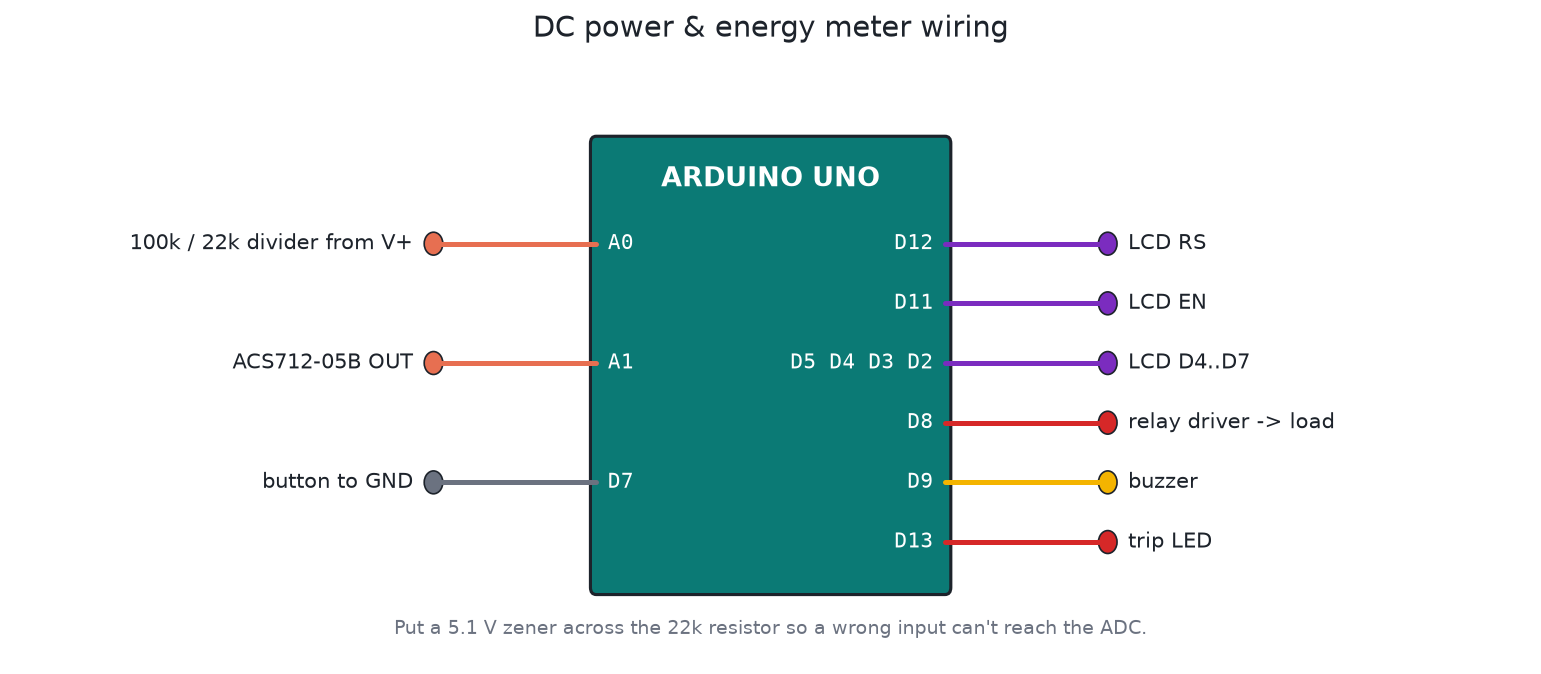
The best sizing starts from measurement, not guesswork. My DC power and energy meter project logs volts, amps, watts and watt-hours from a battery system and cuts the load on over-voltage, over-current, short circuit or low battery. It shows real consumption over a few days, which makes these calculations much more accurate.