Arc Flash Hazards: What Every Industrial Electrician Should Know
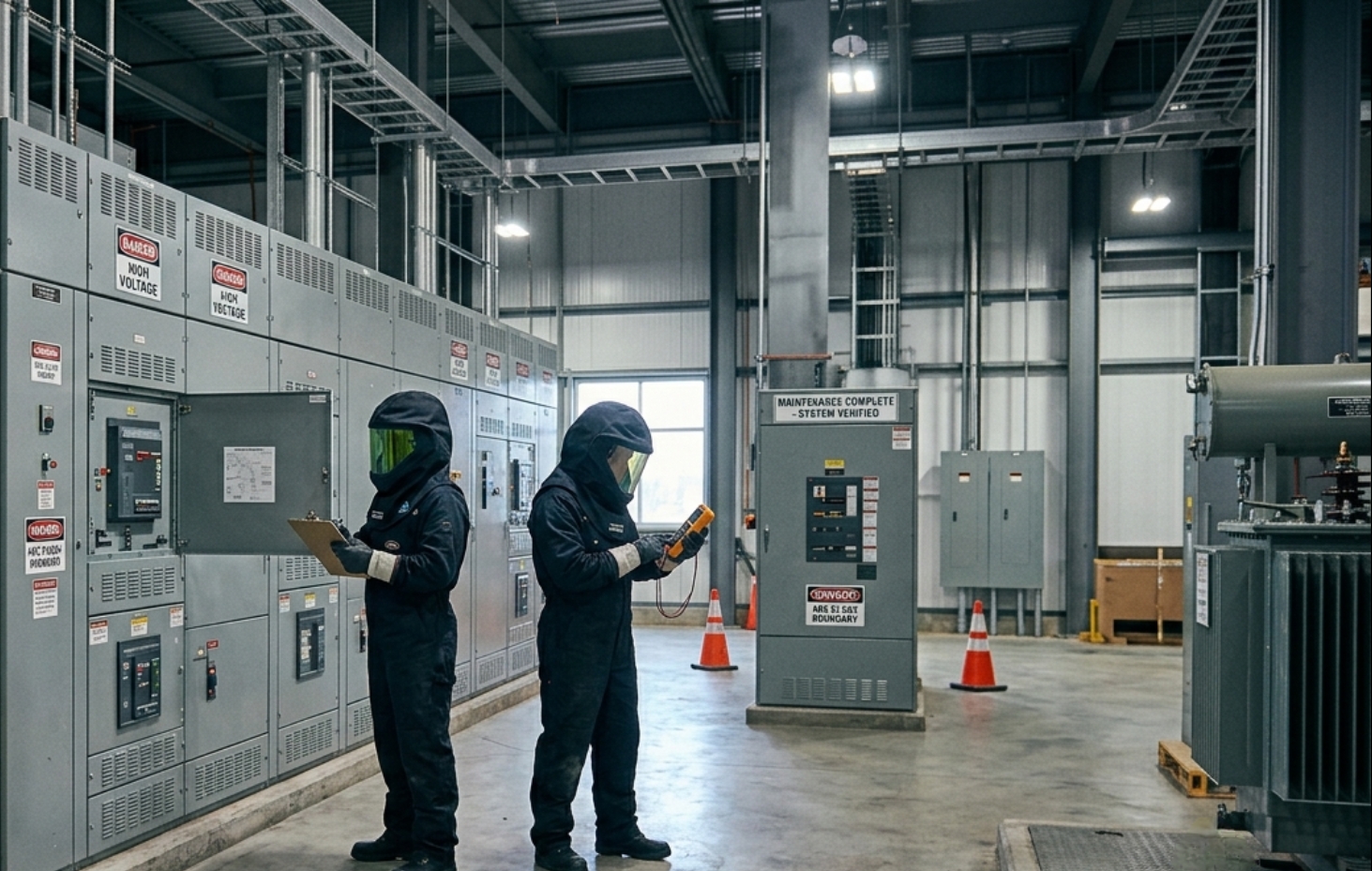
An arc flash event lasts a fraction of a second and can release more thermal energy than most people intuitively associate with electricity at all. It's not the shock hazard people usually picture when they think about electrical danger — it's closer to an explosion, and it's a real, well-documented risk on live or recently-de-energized industrial equipment. What Actually Happens An arc flash occurs when a fault creates a low-impedance path through air between conductors or from a conductor to ground. The resulting arc can reach temperatures several times hotter than the surface of the sun for that brief moment, vaporizing the metal at the arc terminals and generating an intense pressure wave, molten metal spray, and a flash of thermal radiation — all in under a second. The mechanical blast effect (arc blast) can physically throw a person, while the thermal energy can cause severe burns even through standard clothing at a distance. What Triggers One Common causes include dropped tools bridging live conductors, insulation failure, incorrect switching sequences, contamination or corrosion creating a tracking path, and equipment failure from age or manufacturing defects. Crucially, an arc flash doesn't require direct contact with a live conductor — the arc itself can initiate and sustain across an air gap once conditions are right, which is part of why working near energized equipment (not just touching it) carries real risk. Incident Energy: The Number Behind the PPE Category Arc flash risk is quantified as incident energy — the amount of thermal energy a person at a defined working distance would be exposed to during an arc flash event, expressed in calories per square centimeter (cal/cm²). This isn't a fixed number for a piece of equipment; it depends on available fault current, the clearing time of the upstream protective device, the working distance, and the equipment's specific configuration. This is precisely why arc flash studies are equipment-specific and n
An arc flash event lasts a fraction of a second and can release more thermal energy than most people intuitively associate with electricity at all. It's not the shock hazard people usually picture when they think about electrical danger — it's closer to an explosion, and it's a real, well-documented risk on live or recently-de-energized industrial equipment.
What Actually Happens
An arc flash occurs when a fault creates a low-impedance path through air between conductors or from a conductor to ground. The resulting arc can reach temperatures several times hotter than the surface of the sun for that brief moment, vaporizing the metal at the arc terminals and generating an intense pressure wave, molten metal spray, and a flash of thermal radiation — all in under a second. The mechanical blast effect (arc blast) can physically throw a person, while the thermal energy can cause severe burns even through standard clothing at a distance.
What Triggers One
Common causes include dropped tools bridging live conductors, insulation failure, incorrect switching sequences, contamination or corrosion creating a tracking path, and equipment failure from age or manufacturing defects. Crucially, an arc flash doesn't require direct contact with a live conductor — the arc itself can initiate and sustain across an air gap once conditions are right, which is part of why working near energized equipment (not just touching it) carries real risk.
Incident Energy: The Number Behind the PPE Category
Arc flash risk is quantified as incident energy — the amount of thermal energy a person at a defined working distance would be exposed to during an arc flash event, expressed in calories per square centimeter (cal/cm²). This isn't a fixed number for a piece of equipment; it depends on available fault current, the clearing time of the upstream protective device, the working distance, and the equipment's specific configuration.
This is precisely why arc flash studies are equipment-specific and need to be redone whenever upstream protection settings change — a protective device with a slower clearing time lets the arc persist longer, which directly increases incident energy at that point in the system, even if nothing about the equipment itself changed.
PPE Is the Last Line of Defense, Not the First
Arc-rated PPE (rated in cal/cm² to match the calculated incident energy category) is essential when work must be performed on or near energized equipment, but it's explicitly the last layer of protection in a proper hazard hierarchy, not the primary control. The preferred order, following standard risk-hierarchy practice, is:
- Eliminate the hazard — de-energize and verify zero energy state whenever the work doesn't specifically require the equipment to be live.
- Reduce exposure — remote racking/switching devices, infrared windows for thermal scanning without opening panel doors, and maintaining safe working distance wherever possible.
- Administrative controls — proper labeling, permit-to-work systems for any energized work, and enforced boundaries around equipment.
- PPE — arc-rated clothing, face shields, and insulated gloves matched to the calculated incident energy category, worn as the final protective layer once the above controls are in place, not as a substitute for them.
The Habit That Actually Matters
Arc flash labels on equipment aren't a formality — they're the output of a calculation specific to that panel at that point in the system. Treating "de-energize whenever possible" as the default working assumption, rather than relying on PPE to make live work routine, is the single biggest factor separating facilities with a strong safety record from ones that are one bad day away from a serious incident.