Power Quality and Harmonics: Why Your Equipment Fails Even When Voltage Looks Fine
A voltmeter showing a clean 230V or 400V reading tells you almost nothing about whether your power quality is actually good. Voltage magnitude is only one dimension of power quality — and it's entirely possible to have textbook-perfect voltage magnitude while harmonic distortion is quietly overheating transformers, tripping breakers for no obvious reason, and shortening the life of connected equipment. What a Harmonic Actually Is Grid power is designed to be a clean 50 Hz (or 60 Hz) sine wave. A harmonic is a component of the waveform at an integer multiple of that fundamental frequency — the 3rd harmonic at 150 Hz, the 5th at 250 Hz, and so on. These extra frequency components distort the pure sine wave into something that still has roughly the right shape and magnitude on average, but carries additional energy at frequencies the system wasn't designed around. Harmonics don't come from the utility — they're generated by non-linear loads on the customer side: variable frequency drives, LED lighting drivers, UPS systems, computer power supplies, and rectifier-based equipment of all kinds. As these load types have become a larger share of total connected load over the past two decades, harmonic-related power quality problems have become correspondingly more common. Why Harmonics Cause Real Damage The practical effects show up in a few consistent, predictable ways: Transformer overheating: Harmonic currents cause additional eddy current and hysteresis losses in transformer cores beyond what the nameplate rating accounts for. A transformer can be running below its rated kVA and still overheat if the load is harmonic-rich — this is exactly why K-factor rated transformers exist for feeding non-linear loads. Neutral conductor overload: Triplen harmonics (3rd, 9th, 15th, etc.) from single-phase non-linear loads don't cancel in the neutral conductor the way fundamental-frequency currents do on a balanced three-phase system — they add up. It's a well-documented and common
A voltmeter showing a clean 230V or 400V reading tells you almost nothing about whether your power quality is actually good. Voltage magnitude is only one dimension of power quality — and it's entirely possible to have textbook-perfect voltage magnitude while harmonic distortion is quietly overheating transformers, tripping breakers for no obvious reason, and shortening the life of connected equipment.
What a Harmonic Actually Is
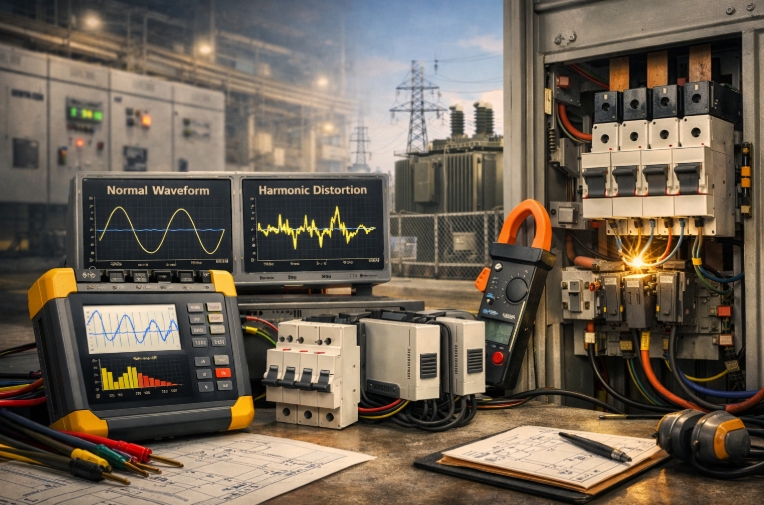
Grid power is designed to be a clean 50 Hz (or 60 Hz) sine wave. A harmonic is a component of the waveform at an integer multiple of that fundamental frequency — the 3rd harmonic at 150 Hz, the 5th at 250 Hz, and so on. These extra frequency components distort the pure sine wave into something that still has roughly the right shape and magnitude on average, but carries additional energy at frequencies the system wasn't designed around.
Harmonics don't come from the utility — they're generated by non-linear loads on the customer side: variable frequency drives, LED lighting drivers, UPS systems, computer power supplies, and rectifier-based equipment of all kinds. As these load types have become a larger share of total connected load over the past two decades, harmonic-related power quality problems have become correspondingly more common.
Why Harmonics Cause Real Damage
The practical effects show up in a few consistent, predictable ways:
- Transformer overheating: Harmonic currents cause additional eddy current and hysteresis losses in transformer cores beyond what the nameplate rating accounts for. A transformer can be running below its rated kVA and still overheat if the load is harmonic-rich — this is exactly why K-factor rated transformers exist for feeding non-linear loads.
- Neutral conductor overload: Triplen harmonics (3rd, 9th, 15th, etc.) from single-phase non-linear loads don't cancel in the neutral conductor the way fundamental-frequency currents do on a balanced three-phase system — they add up. It's a well-documented and common failure mode for neutral conductors in buildings with heavy non-linear loading (a floor full of computers and LED lighting is a classic case) to carry more current than any individual phase conductor, despite being sized the same or smaller.
- Nuisance breaker tripping: Harmonic currents distort the true RMS value of current in ways that some older or improperly rated protective devices measure incorrectly, leading to trips that look unexplained on a simple ammeter check.
- Reduced motor and capacitor life: Harmonics increase motor heating and vibration, and can cause resonance conditions with power factor correction capacitors that amplify specific harmonic frequencies well beyond their original magnitude.
Measuring It Properly
Total Harmonic Distortion (THD) is the standard metric — expressed as a percentage comparing the RMS value of all harmonic components to the RMS value of the fundamental. IEEE 519 and similar standards set THD limits depending on the system voltage level and the point of common coupling, typically keeping voltage THD under 5% and current THD limits scaled based on the ratio of short-circuit current to load current.
The catch is that a standard clamp meter or basic voltmeter won't show THD at all — it needs a true-RMS meter at minimum, and proper harmonic analysis requires a power quality analyzer capable of spectral (FFT-based) measurement across individual harmonic orders, not just an aggregate THD number.
Mitigation, in Order of Practicality
- Passive harmonic filters: Tuned LC filters targeting specific dominant harmonic orders (commonly 5th and 7th for VFD-heavy loads). Cost-effective for a known, stable harmonic profile.
- Active harmonic filters: Inverter-based devices that inject a real-time compensating waveform, adapting to changing load conditions. More expensive but effective across a broader and shifting harmonic spectrum.
- 12-pulse or multi-pulse rectifier configurations: For large VFD or rectifier loads, using higher-pulse-number topologies cancels specific low-order harmonics at the source rather than filtering them downstream.
- Derated (K-factor) transformers and oversized neutral conductors: Not a fix for the harmonics themselves, but a practical design accommodation where the harmonic-generating load can't be changed.
The Takeaway
Power quality problems caused by harmonics are chronically underdiagnosed because the standard troubleshooting instinct — check the voltage — genuinely won't show the problem. If equipment is overheating, breakers are tripping intermittently, or neutral conductors are running warm on an installation with a lot of VFDs, LED lighting, or IT loads, a harmonic-spectrum measurement should be on the checklist well before assuming a wiring fault or equipment defect.