Circuit Breaker Selection and Coordination: Getting Protection Right the First Time
Picking a circuit breaker sounds like it should be simple — match the rating to the load, done. In practice, a breaker that's correctly sized for its own circuit can still cause a much bigger outage than necessary if it isn't coordinated properly with the breakers upstream and downstream of it. Sizing is only half the job. Sizing: The Part Most People Get Right Breaker sizing starts with the load's full-load current, then applies standard derating and safety margin per the applicable code (commonly sizing the breaker at 100–125% of continuous load current depending on local code and duty classification). Beyond straightforward current rating, a few other parameters matter just as much: Breaking capacity (interrupting rating): The breaker has to be able to safely interrupt the maximum fault current available at its point of installation, not just the load current it normally carries. Undersized breaking capacity is a serious hazard — the breaker can physically fail to safely clear a real fault. Trip curve: Different trip characteristic curves (commonly labeled B, C, D for MCBs) suit different load types. A motor's inrush current needs a trip curve tolerant of that brief surge, while a curve too tolerant on a purely resistive load delays protection unnecessarily. Coordination: Where It Actually Gets Interesting Coordination (also called discrimination or selectivity) is about making sure that when a fault occurs, only the breaker closest to the fault trips — not every breaker between the fault and the main incomer. Without proper coordination, a fault on a single branch circuit can trip an upstream breaker serving dozens of other unrelated circuits, taking down far more of the facility than the actual fault justified. Two main coordination approaches are used: Time-based discrimination: Upstream breakers are set with a deliberately longer time delay than downstream ones, giving the downstream breaker a head start to clear the fault first. Simple to design, but th
Picking a circuit breaker sounds like it should be simple — match the rating to the load, done. In practice, a breaker that's correctly sized for its own circuit can still cause a much bigger outage than necessary if it isn't coordinated properly with the breakers upstream and downstream of it. Sizing is only half the job.
Sizing: The Part Most People Get Right
Breaker sizing starts with the load's full-load current, then applies standard derating and safety margin per the applicable code (commonly sizing the breaker at 100–125% of continuous load current depending on local code and duty classification). Beyond straightforward current rating, a few other parameters matter just as much:
- Breaking capacity (interrupting rating): The breaker has to be able to safely interrupt the maximum fault current available at its point of installation, not just the load current it normally carries. Undersized breaking capacity is a serious hazard — the breaker can physically fail to safely clear a real fault.
- Trip curve: Different trip characteristic curves (commonly labeled B, C, D for MCBs) suit different load types. A motor's inrush current needs a trip curve tolerant of that brief surge, while a curve too tolerant on a purely resistive load delays protection unnecessarily.
Coordination: Where It Actually Gets Interesting
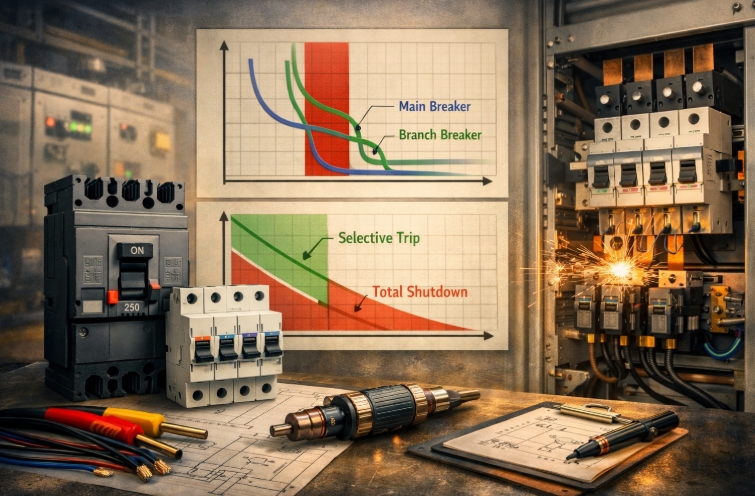
Coordination (also called discrimination or selectivity) is about making sure that when a fault occurs, only the breaker closest to the fault trips — not every breaker between the fault and the main incomer. Without proper coordination, a fault on a single branch circuit can trip an upstream breaker serving dozens of other unrelated circuits, taking down far more of the facility than the actual fault justified.
Two main coordination approaches are used:
- Time-based discrimination: Upstream breakers are set with a deliberately longer time delay than downstream ones, giving the downstream breaker a head start to clear the fault first. Simple to design, but the added delay upstream means fault current flows for slightly longer before anything trips.
- Current-based (zone) discrimination: Breakers communicate fault current magnitude between zones, allowing faster overall clearing while still maintaining selectivity — more sophisticated, and increasingly common on modern electronic trip units, but it depends on the breakers actually supporting that communication.
A Common Real-World Mistake
One of the more frequent coordination failures shows up after equipment gets replaced or upgraded in isolation — a downstream breaker gets swapped for a newer model with a different trip curve, without anyone re-checking whether it's still properly coordinated with what's upstream of it. The new breaker might individually be a perfectly good, correctly sized device, and the installation can pass a basic functional test, while the coordination between it and the rest of the system has quietly broken. This is exactly why a full coordination study — not just individual breaker sizing — is standard practice for any non-trivial distribution system, and why it's worth revisiting after any equipment change, not just at initial design.
The Takeaway
A correctly sized breaker that isn't coordinated with its neighbors can still cause a bigger outage than necessary when a fault occurs. Sizing answers "can this breaker handle its own circuit," while coordination answers "does a fault here take down only what it needs to" — and a protection scheme is only actually complete when both questions have real answers, not just the first one.