Power Factor Correction in Industrial Plants: Why It Matters and How to Fix It
What Is Power Factor and Why NEA Penalises Low Values
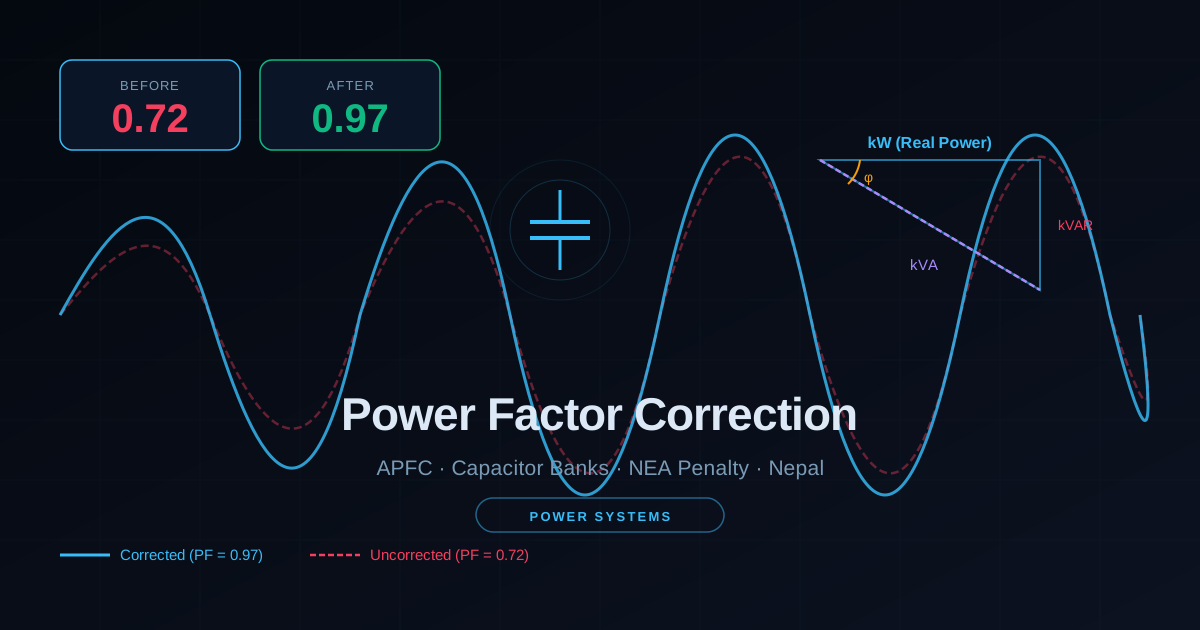
Power factor is the ratio of real power (kW) consumed by equipment to apparent power (kVA) drawn from the supply. A power factor of 1.0 means every ampere drawn from the grid does useful work. A power factor of 0.7 means only 70% of the current drawn actually produces useful output u2014 the remaining 30% circulates uselessly, heating cables and transformers without doing work.
Nepal Electricity Authority (NEA) charges commercial and industrial consumers a power factor penalty when monthly average power factor falls below 0.9. This penalty is typically 0.2% of the electricity bill per 0.01 drop below 0.9 u2014 a factory with a power factor of 0.75 can face a penalty of 3% or more added to every bill, every month, for years.
What Causes Low Power Factor
- Induction motors running at partial load (most common cause in Nepalu2019s factories)
- Transformers operating below rated capacity
- Fluorescent lighting with magnetic ballasts (older installations)
- Welding machines and arc furnaces
- Uninterruptible Power Supplies (UPS) with poor internal power factor
- Large number of variable-speed drives without line reactors
How to Measure Your Plantu2019s Power Factor
The simplest method is to read your NEA meter directly u2014 modern digital meters display kW, kVAR, kVA, and power factor on their display. For a more detailed picture, use a power quality analyser connected at the main incomer for at least one full production week. This reveals not just average power factor but its variation throughout the day and identifies which equipment causes the worst degradation.
Capacitor Bank Sizing Calculation
The required capacitor bank size in kVAR is calculated as: kVAR = kW u00d7 (tanu03c6u2081 u2212 tanu03c6u2082), where u03c6u2081 is the existing power factor angle and u03c6u2082 is the target power factor angle. For example, a factory consuming 500 kW at 0.75 power factor wanting to correct to 0.95 needs: 500 u00d7 (tan(41.4u00b0) u2212 tan(18.2u00b0)) = 500 u00d7 (0.882 u2212 0.329) = 277 kVAR of capacitor compensation.
Fixed vs Automatic Capacitor Banks
Fixed capacitor banks connect a constant kVAR rating permanently. These work well when loads are stable and consistent. Automatic power factor correction (APFC) panels use a controller that monitors power factor in real time and switches capacitor steps in and out to maintain a target value. For most Nepali industrial plants where load varies significantly between shifts and weekends, APFC panels are the correct choice.
Detuned Reactors u2014 Preventing Harmonic Problems
Plants with significant variable-speed drive loads produce harmonic currents (5th, 7th harmonics predominantly). Plain capacitors connected in such plants resonate with these harmonics, causing capacitor failures and increased harmonic distortion. Detuned reactors (typically tuned to 189 Hz for a 50 Hz system) installed in series with each capacitor step prevent this resonance. Always specify detuned reactor capacitor banks when more than 20% of load is from VFDs.
Return on Investment
Power factor correction has one of the fastest ROI in electrical engineering. A typical APFC panel installation for a medium-sized factory in Nepal (requiring 200u2013400 kVAR) costs NPR 3u20136 lakh installed. The monthly saving from eliminated NEA penalty plus reduced cable losses typically recovers this cost within 12u201318 months. After payback, the savings continue indefinitely.