Smart parking system
A 6-slot car park with an entry barrier, an exit barrier, and a display that always shows the real number of free spaces. It's the kind of system a municipality, hospital or shopping centre in Kathmandu could use, and it scales up by adding sensors.
Why sensors in every slot
A lot of parking counters just count cars in and out. That drifts during the day: a motorbike squeezes past, someone reverses out the entrance, a sensor misses one. Here every slot has its own IR sensor, so the free count is the actual state of the car park, every second.
What it does
- The LCD shows
Free 3/6and a slot map like1X2-3X4-5-6X(X = taken). A FULL lamp lights when there's no space. - The entry barrier opens only if a slot is free. When the car park is full, the driver gets a beep and "PARKING FULL", and the barrier stays down.
- The exit barrier always opens for a car leaving.
- A barrier never closes on a car. It waits until the car has fully passed, plus 2 s. If a car appears under a barrier that's coming down, it goes back up, even when the car park is full. Safety comes before the slot count.
- If a car sits at an open barrier for 20 s, the buzzer calls the attendant.
- Slot sensors are filtered for 1.5 s, so people walking past and reflections don't flicker the count.
- Barriers move slowly and smoothly (about 1 s for 90°) instead of slamming.
- Every event is logged over USB as CSV:
EVENT,seconds,event,free_slots.
Files
| File | What it is |
|---|---|
firmware/smart_parking/smart_parking.ino | Firmware |
firmware/build/smart_parking.hex | Build (no speed-up needed) |
test/sim_test.c | Simulator test |
Building it in Proteus
- Add
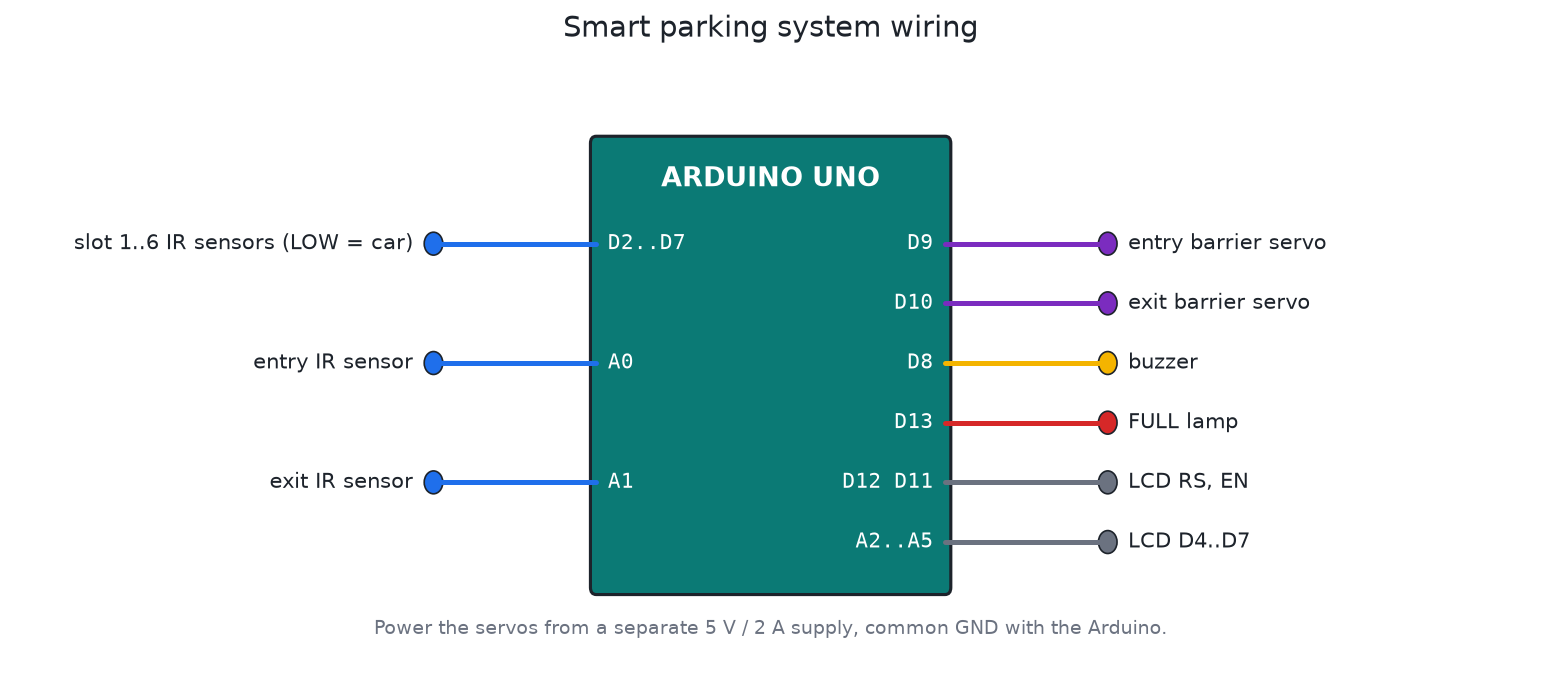
ARDUINO UNO,LM016L, 2 ×MOTOR-SERVO,BUZZER,LED-RED, and 8 ×SW-SPSTorLOGICSTATEfor the 6 slots plus the entry and exit sensors. - Wire it as in
images/wiring.png. Each sensor input reads LOW when a car is there. - Set the Arduino's Program File to
firmware/build/smart_parking.hexand run it. Close the entry switch to bring a car in, then close a slot switch to park it.
Save it as proteus/smart-parking.pdsprj and commit it.
Scaling up
For more than 6 slots, use 74HC165 shift registers (8 slots each, 3 pins total) or one ESP32 per row reporting over Wi-Fi to a display at the gate. The barrier logic stays the same.
Testing
The test covers both barriers down at start, the first car with the 2 s close delay, the slot sensor filter, filling all 6 slots, the FULL lamp and a refused car, a car leaving, the tailgater safety re-open when the car park has just become full, and the attendant warning.