Three-Phase Power Explained: Why Industry Runs on It
Anyone who's worked around industrial equipment has run into the distinction quickly: the office lighting runs on single-phase, but the moment you're near a real motor, a compressor, or an industrial oven, it's almost always three-phase. The reason isn't arbitrary — three-phase power solves real, practical problems that single-phase simply can't. What "Three-Phase" Actually Means Single-phase power delivers one alternating current waveform. Three-phase power delivers three separate waveforms, each offset from the other by 120 electrical degrees, typically carried on three (or four, including neutral) conductors from the same generation source. Picture three sine waves overlapping, each starting its cycle a third of a rotation after the last — that phase offset is the entire trick behind why three-phase behaves so differently from single-phase. The Core Advantage: Constant Power Delivery A single-phase AC waveform's instantaneous power output actually pulses — it rises and falls twice per cycle, hitting zero twice every cycle as the voltage crosses zero. A three-phase system, because the three phases are offset, delivers constant total power at every instant — the dips in one phase are covered by the other two being at a different point in their cycle. For a motor, that constant power delivery means smoother torque and less vibration compared to a single-phase motor of similar power, which is a big part of why virtually all serious industrial motors are three-phase. Star and Delta: The Two Ways to Connect It Three-phase windings (in a motor, transformer, or generator) are connected in one of two configurations, and the choice affects both voltage relationships and how the system behaves under fault conditions: Star (Wye) connection: One end of each of the three windings joins at a common neutral point. This configuration provides access to both line voltage (between any two phases) and phase voltage (between a phase and neutral) — which is exactly why residential
Anyone who's worked around industrial equipment has run into the distinction quickly: the office lighting runs on single-phase, but the moment you're near a real motor, a compressor, or an industrial oven, it's almost always three-phase. The reason isn't arbitrary — three-phase power solves real, practical problems that single-phase simply can't.
What "Three-Phase" Actually Means
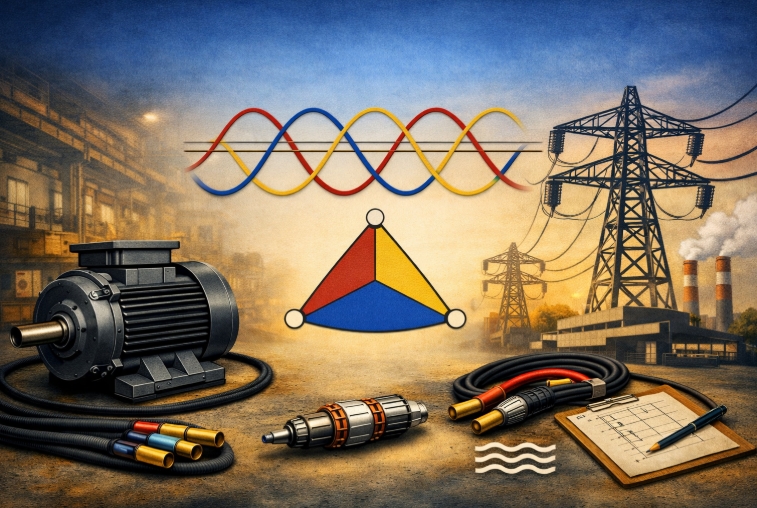
Single-phase power delivers one alternating current waveform. Three-phase power delivers three separate waveforms, each offset from the other by 120 electrical degrees, typically carried on three (or four, including neutral) conductors from the same generation source. Picture three sine waves overlapping, each starting its cycle a third of a rotation after the last — that phase offset is the entire trick behind why three-phase behaves so differently from single-phase.
The Core Advantage: Constant Power Delivery
A single-phase AC waveform's instantaneous power output actually pulses — it rises and falls twice per cycle, hitting zero twice every cycle as the voltage crosses zero. A three-phase system, because the three phases are offset, delivers constant total power at every instant — the dips in one phase are covered by the other two being at a different point in their cycle. For a motor, that constant power delivery means smoother torque and less vibration compared to a single-phase motor of similar power, which is a big part of why virtually all serious industrial motors are three-phase.
Star and Delta: The Two Ways to Connect It
Three-phase windings (in a motor, transformer, or generator) are connected in one of two configurations, and the choice affects both voltage relationships and how the system behaves under fault conditions:
- Star (Wye) connection: One end of each of the three windings joins at a common neutral point. This configuration provides access to both line voltage (between any two phases) and phase voltage (between a phase and neutral) — which is exactly why residential and commercial distribution transformers are typically star-connected on the low-voltage side, giving both a higher voltage for three-phase loads and a lower, safer voltage for single-phase loads off the same transformer.
- Delta connection: The windings form a closed triangle, with each phase connected end-to-end to the next. There's no neutral point, so delta typically supplies only line-to-line voltage. Delta connections are common on the primary (high-voltage) side of distribution transformers, partly because they don't provide a path for triplen harmonic currents to circulate onto the upstream network the way certain other configurations can.
Motor starting also uses this distinction directly: a star-delta starter connects the motor windings in star during startup (reducing starting current and inrush), then switches to delta for normal running once the motor is up to speed — a simple, still widely-used method for reducing the startup current surge on larger induction motors without needing a full variable frequency drive.
Why This Matters Beyond Theory
Understanding star versus delta isn't academic — it directly affects troubleshooting. A motor that hums and struggles to start but doesn't trip immediately is a classic symptom of losing one phase (single-phasing) on a three-phase supply, and recognizing that symptom quickly, rather than assuming a mechanical fault, is often the difference between a five-minute fix (a blown fuse or loose terminal) and hours spent chasing the wrong problem.