Motor Control Centers (MCC): Design, Components, and Common Failure Points
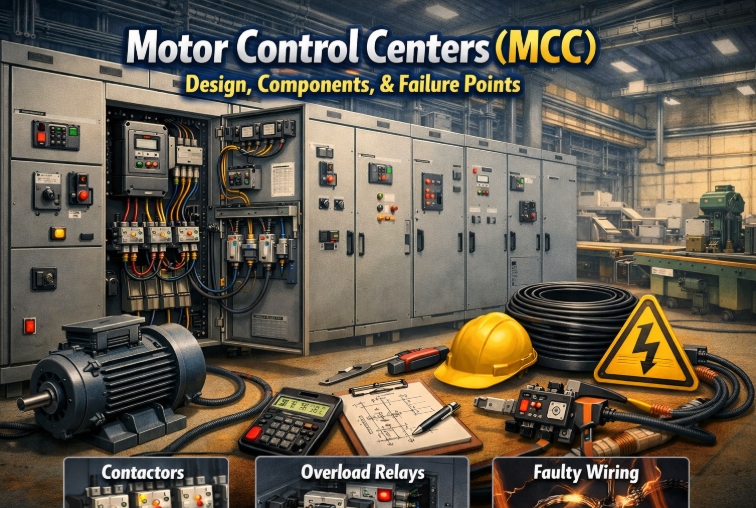
Walk into almost any industrial facility and somewhere on the floor there's a row of grey cabinets humming quietly, each one controlling a motor somewhere else in the plant. That's the motor control center — and for how central it is to keeping production running, it's remarkably under-discussed outside of the maintenance team that actually has to keep it healthy. What an MCC Actually Is A motor control center is a modular assembly of individual motor starter units, each housed in its own compartment (or "bucket"), all fed from a common set of vertical bus bars running the height of the cabinet. Instead of wiring individual starters scattered across a facility back to a switchboard, an MCC centralizes them into one structure — simplifying maintenance, troubleshooting, and future additions, since a new motor circuit is often just a matter of adding another bucket rather than rewiring from scratch. What's Inside Each Unit A typical MCC bucket for a standard motor isn't just a single component — it's a small coordinated system: Isolator / disconnect switch: Physically isolates the unit from the bus for safe maintenance, often interlocked so the door can't open with the unit energized. Circuit breaker or fuses: Provides short-circuit protection, sized to clear a fault fast without nuisance-tripping on the motor's normal starting inrush current. Contactor: The actual switching device that energizes the motor, rated for the specific duty cycle and switching frequency the application needs. Overload relay: Protects the motor itself from sustained overcurrent — a mechanically stalled motor, a bearing dragging, or a motor running single-phase after losing one supply leg. This is the component most directly protecting the motor winding from thermal damage. Control circuit: The lower-voltage wiring handling start/stop commands, interlocks, and status indication — increasingly tied into a PLC rather than standalone push-buttons on modern installations. Where MCCs Actually
Walk into almost any industrial facility and somewhere on the floor there's a row of grey cabinets humming quietly, each one controlling a motor somewhere else in the plant. That's the motor control center — and for how central it is to keeping production running, it's remarkably under-discussed outside of the maintenance team that actually has to keep it healthy.
What an MCC Actually Is
A motor control center is a modular assembly of individual motor starter units, each housed in its own compartment (or "bucket"), all fed from a common set of vertical bus bars running the height of the cabinet. Instead of wiring individual starters scattered across a facility back to a switchboard, an MCC centralizes them into one structure — simplifying maintenance, troubleshooting, and future additions, since a new motor circuit is often just a matter of adding another bucket rather than rewiring from scratch.
What's Inside Each Unit
A typical MCC bucket for a standard motor isn't just a single component — it's a small coordinated system:
- Isolator / disconnect switch: Physically isolates the unit from the bus for safe maintenance, often interlocked so the door can't open with the unit energized.
- Circuit breaker or fuses: Provides short-circuit protection, sized to clear a fault fast without nuisance-tripping on the motor's normal starting inrush current.
- Contactor: The actual switching device that energizes the motor, rated for the specific duty cycle and switching frequency the application needs.
- Overload relay: Protects the motor itself from sustained overcurrent — a mechanically stalled motor, a bearing dragging, or a motor running single-phase after losing one supply leg. This is the component most directly protecting the motor winding from thermal damage.
- Control circuit: The lower-voltage wiring handling start/stop commands, interlocks, and status indication — increasingly tied into a PLC rather than standalone push-buttons on modern installations.
Where MCCs Actually Fail in the Field
A handful of failure modes account for a disproportionate share of MCC-related downtime:
- Contactor contact wear: Every switching cycle erodes the contact surface slightly. High switching frequency applications (conveyor systems with frequent start-stop cycles, for instance) wear contacts faster than continuous-run motors, and worn contacts eventually arc, pit, and generate heat that can cascade into a bigger failure.
- Overload relay miscalibration: An overload relay set too high won't protect the motor; set too low, it nuisance-trips a perfectly healthy motor. Overload settings need to actually match the motor's full-load current, and they're one of the more commonly neglected settings after an equipment swap or motor rewind changes the actual FLA slightly.
- Loose bus connections: Vibration over time loosens bus bar and cable lug connections, creating a high-resistance joint that heats under load — often visible on thermal imaging well before it becomes a visible failure, which is exactly why routine thermal scanning of MCC bus connections is standard preventive maintenance practice in well-run facilities.
- Single-phasing: A blown fuse or a loose connection on one phase can leave a three-phase motor running on two phases, drawing excessive current on the remaining phases while producing a distinctive humming/vibration. Overload protection is meant to catch this, but only if it's actually calibrated correctly.
Preventive Maintenance That Actually Moves the Needle
The highest-value MCC maintenance tasks are unglamorous and recurring: periodic thermal imaging of bus connections, torque-checking bolted connections against a schedule, testing overload relay trip settings against actual motor nameplate data, and visually inspecting contactor contacts during scheduled outages rather than waiting for a failure to force one. None of this is complicated work — it's just work that's easy to defer when everything currently seems to be running fine, right up until it isn't.