SCADA Systems in Power Distribution: How Utilities Monitor the Grid in Real Time
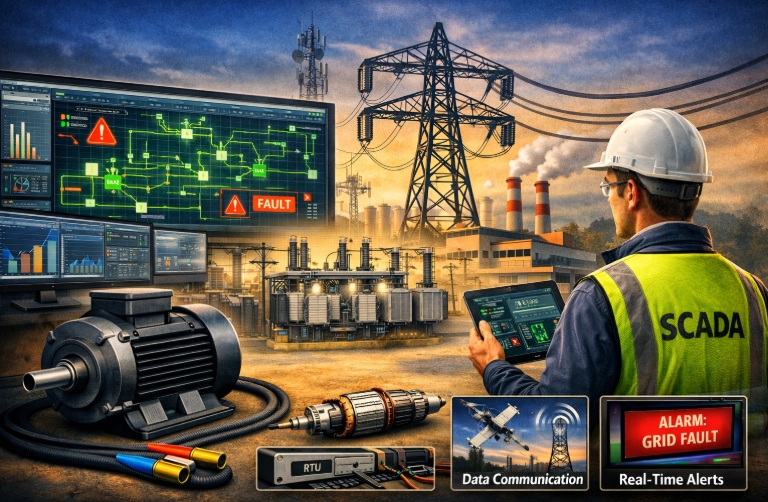
A modern distribution utility isn't managed by someone driving between substations checking meters. It's managed from a control room, watching a live single-line diagram update in real time as breakers open and close, loads shift, and voltages fluctuate across a network that might span an entire region. That real-time visibility is SCADA — Supervisory Control and Data Acquisition — and it's the backbone of how modern grids are actually operated. The Basic Architecture SCADA systems follow a layered structure, and understanding the layers explains a lot about how the system behaves: Field devices: Circuit breakers, switches, transformers, and sensors physically located at substations and along the distribution network. RTUs (Remote Terminal Units) / IEDs (Intelligent Electronic Devices): Hardware at each substation that interfaces directly with field equipment, converting physical signals (voltage, current, breaker status) into data the system can transmit, and executing remote control commands sent back down to the equipment. Communication network: Fiber, radio, cellular, or leased lines carrying data between substations and the central control system — and one of the more operationally fragile links in the whole chain, since a communication failure can leave the control room "blind" to a substation even though the equipment itself is functioning normally. Master station / HMI: The central software presenting operators with a live visual representation of the network, alarms, trends, and the interface for issuing remote control commands. What Operators Actually Do With It Real-time SCADA data lets operators see load flow across the network, spot abnormal voltage or current conditions before they cascade into a bigger problem, remotely operate breakers and switches to isolate a faulted section without dispatching a crew first, and reconfigure the network topology to restore service to unaffected customers while a faulted section is repaired. This last function —
A modern distribution utility isn't managed by someone driving between substations checking meters. It's managed from a control room, watching a live single-line diagram update in real time as breakers open and close, loads shift, and voltages fluctuate across a network that might span an entire region. That real-time visibility is SCADA — Supervisory Control and Data Acquisition — and it's the backbone of how modern grids are actually operated.
The Basic Architecture
SCADA systems follow a layered structure, and understanding the layers explains a lot about how the system behaves:
- Field devices: Circuit breakers, switches, transformers, and sensors physically located at substations and along the distribution network.
- RTUs (Remote Terminal Units) / IEDs (Intelligent Electronic Devices): Hardware at each substation that interfaces directly with field equipment, converting physical signals (voltage, current, breaker status) into data the system can transmit, and executing remote control commands sent back down to the equipment.
- Communication network: Fiber, radio, cellular, or leased lines carrying data between substations and the central control system — and one of the more operationally fragile links in the whole chain, since a communication failure can leave the control room "blind" to a substation even though the equipment itself is functioning normally.
- Master station / HMI: The central software presenting operators with a live visual representation of the network, alarms, trends, and the interface for issuing remote control commands.
What Operators Actually Do With It
Real-time SCADA data lets operators see load flow across the network, spot abnormal voltage or current conditions before they cascade into a bigger problem, remotely operate breakers and switches to isolate a faulted section without dispatching a crew first, and reconfigure the network topology to restore service to unaffected customers while a faulted section is repaired. This last function — splitting a network into isolated sections and re-routing power around a fault — is a big part of why modern outage restoration is often measured in minutes for the unaffected majority of customers, even when the actual physical repair takes much longer.
Where SCADA Runs Into Real Limits
A few practical constraints shape how much a utility can actually rely on SCADA:
- Not every device is remotely controllable. Retrofitting older switchgear with remote control capability is expensive, so many distribution networks still have a mix of fully SCADA-integrated substations and older manually-operated equipment that still needs a crew dispatched physically.
- Communication reliability. A substation that loses its communication link effectively goes dark to the control room even if the equipment is working fine — which is why many SCADA architectures include local automatic protection logic at the substation level that operates independently of the central system, rather than relying entirely on remote commands for critical protection functions.
- Cybersecurity. A system that can remotely operate breakers across a grid is a serious target, and securing SCADA networks (network segmentation, authentication, monitoring for anomalous command patterns) is now treated as core infrastructure security, not an afterthought.
The Bigger Picture
SCADA is what turns a distribution network from a collection of physically separate substations into something that can be operated as one coordinated system in real time. As distributed generation (rooftop solar, battery storage) adds more variability to how power actually flows through a network, that real-time visibility only becomes more essential — a static, manually-operated grid simply can't respond fast enough to the kind of dynamic conditions modern distribution networks increasingly deal with.