Lightning Protection Systems for Industrial and Residential Buildings
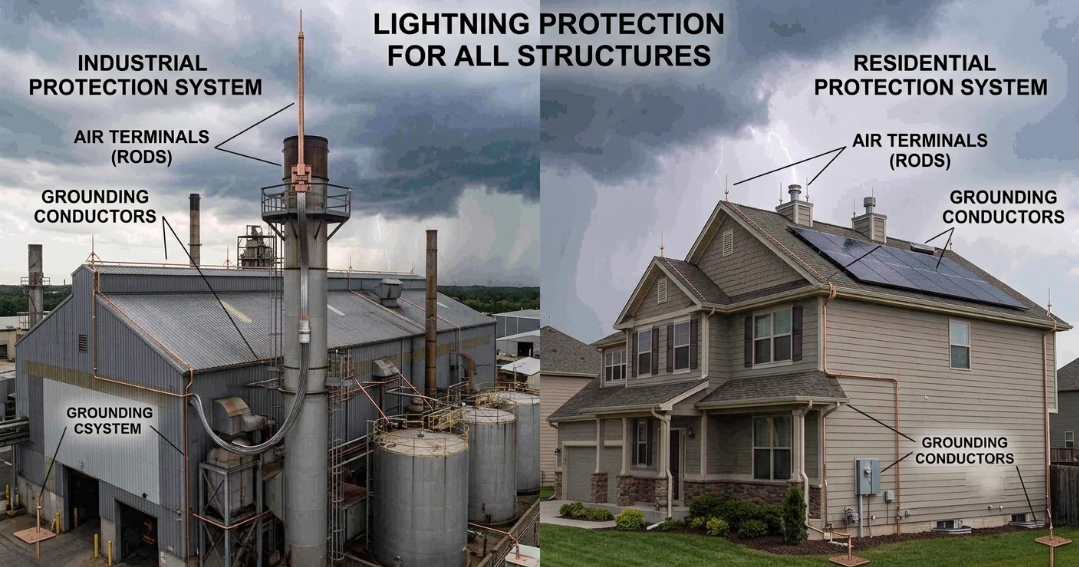
A direct lightning strike carries currents that can reach tens of thousands of amps for a brief but destructive moment. A lightning protection system's job isn't to stop lightning from striking — that's not physically achievable — it's to give that strike a deliberate, low-impedance path to ground that keeps the current away from the building structure, its occupants, and its electrical systems. The Three Core Components A conventional lightning protection system is built from three coordinated parts, and all three need to work together for the system to actually do its job: Air terminals (lightning rods): Elevated conductive points positioned to intercept a strike preferentially, rather than letting it strike an uncontrolled point on the structure. Placement follows established protection zone methods (like the rolling sphere method) to determine how many terminals a building needs and where, rather than a single rod being assumed sufficient for any size or shape of building. Down conductors: Low-impedance paths carrying the intercepted strike current from the air terminals down to the earthing system, sized and routed to avoid sharp bends (which increase impedance right when the system needs to be at its lowest) and kept a safe separation distance from other building services to avoid dangerous side-flashing. Earth termination system: Where the current is finally dissipated into the ground, typically a network of earth electrodes bonded together rather than a single rod, since distributing the dissipation point reduces the localized ground potential rise at any single point. Bonding: The Part That's Easy to Underestimate All conductive services entering a building — metal water pipes, gas lines, structural steel, cable shields — need to be bonded into the same earthing system as the lightning protection system itself. Without that bonding, a lightning strike can create a large voltage difference between the lightning protection earth and another supposedly-sep
A direct lightning strike carries currents that can reach tens of thousands of amps for a brief but destructive moment. A lightning protection system's job isn't to stop lightning from striking — that's not physically achievable — it's to give that strike a deliberate, low-impedance path to ground that keeps the current away from the building structure, its occupants, and its electrical systems.
The Three Core Components
A conventional lightning protection system is built from three coordinated parts, and all three need to work together for the system to actually do its job:
- Air terminals (lightning rods): Elevated conductive points positioned to intercept a strike preferentially, rather than letting it strike an uncontrolled point on the structure. Placement follows established protection zone methods (like the rolling sphere method) to determine how many terminals a building needs and where, rather than a single rod being assumed sufficient for any size or shape of building.
- Down conductors: Low-impedance paths carrying the intercepted strike current from the air terminals down to the earthing system, sized and routed to avoid sharp bends (which increase impedance right when the system needs to be at its lowest) and kept a safe separation distance from other building services to avoid dangerous side-flashing.
- Earth termination system: Where the current is finally dissipated into the ground, typically a network of earth electrodes bonded together rather than a single rod, since distributing the dissipation point reduces the localized ground potential rise at any single point.
Bonding: The Part That's Easy to Underestimate
All conductive services entering a building — metal water pipes, gas lines, structural steel, cable shields — need to be bonded into the same earthing system as the lightning protection system itself. Without that bonding, a lightning strike can create a large voltage difference between the lightning protection earth and another supposedly-separate metal system in the building, and that voltage difference is exactly what causes a dangerous side-flash between the two systems during a strike. This bonding requirement is a big part of why lightning protection design isn't just a rooftop installation — it touches nearly every conductive service in the building.
Surge Protection: The Part That Handles What Reaches Equipment Anyway
Even a well-designed lightning protection system dealing with a direct strike doesn't protect sensitive electronics from the transient voltage surges that lightning induces on power and data lines — both from a direct strike elsewhere on the same network and from nearby strikes that induce a surge without a direct hit at all. That's a separate layer: surge protection devices (SPDs) installed at the main distribution board and, for genuinely sensitive equipment, at the point of use as well, clamping transient overvoltages before they reach connected equipment.
A facility can have a technically compliant structural lightning protection system and still lose sensitive electronics repeatedly to induced surges if SPDs aren't part of the design — the two systems address genuinely different failure paths, and treating them as one solved problem once the rooftop terminals are installed is a common and costly gap.
The Practical Takeaway
Lightning protection isn't a single component you bolt onto a roof — it's a coordinated system of interception, low-impedance conduction, proper earthing, comprehensive bonding, and a separate surge protection layer for what still reaches sensitive equipment despite all of that. Treating any one piece as sufficient on its own is where real installations most often fall short of actually protecting what they're meant to protect.