Jalpadevi Cable Car : Complete Technical Guide
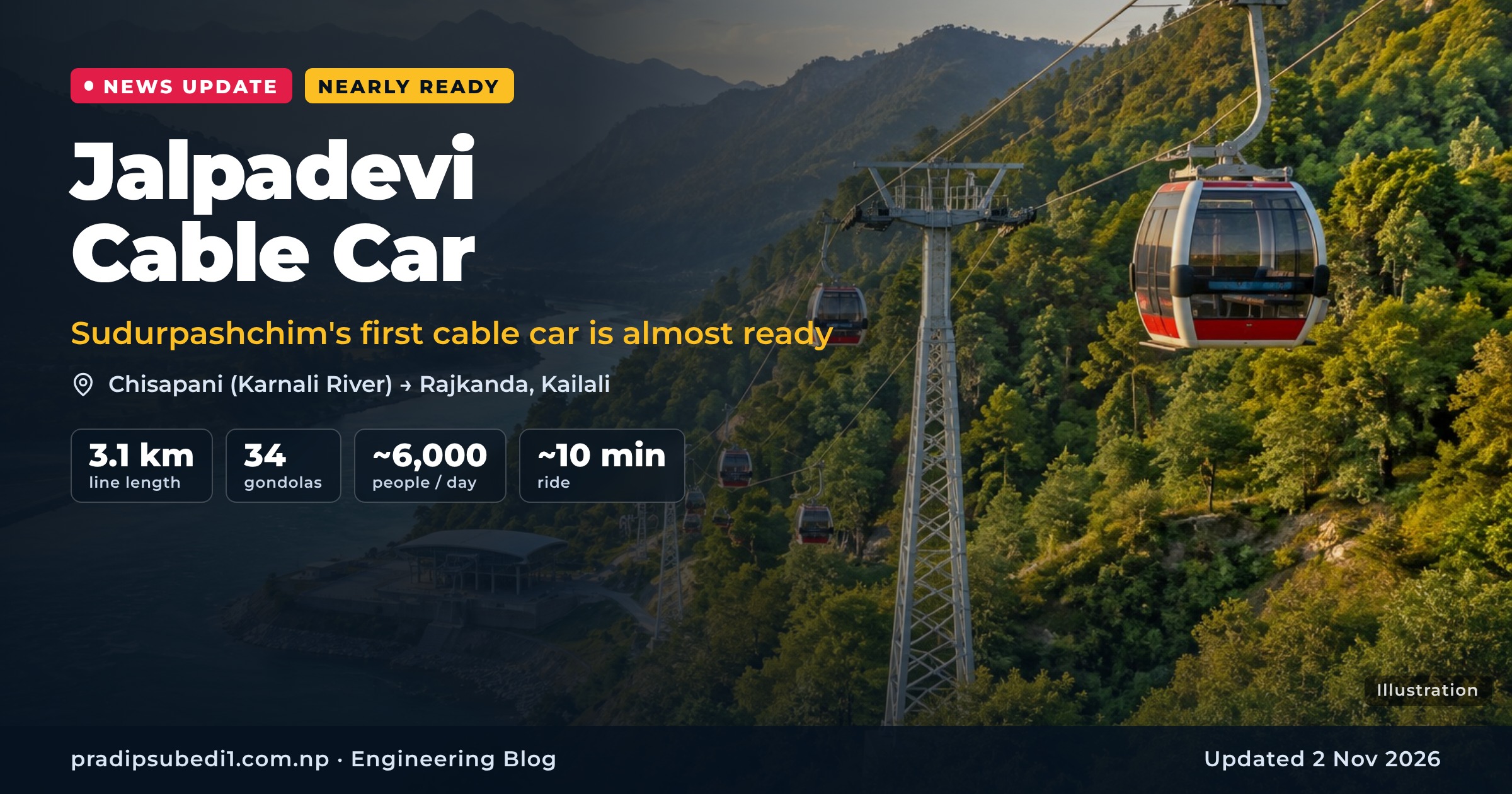
The Jalpadevi Cable Car, Sudurpashchim Province's first cable car, will start commercial operation on 1 January 2027. The line rises 1,005 m from Chisapani on the banks of the Karnali River to the Jalpadevi temple at Rajkanda, with 42 gondolas running at 6 m/s on a 50 mm haul rope, built with LEITNER Ropeways technology from Italy.
For electrical and mechanical engineering students, Jalpadevi is an excellent case study. It has a top drive station, three 250 kW variable frequency drives, a single-cylinder hydraulic tensioning system, external LPA detachable grips and a flexible operating plan that changes the number of cabins on the line with passenger demand.
This guide covers the complete technical data, the drive and electrical system, line and gondola operation, and the project's journey to opening day.
Opening: Commercial operation of the Jalpadevi Cable Car starts on 1 January 2027.
PART 1: Project Overview
| Parameter | Details |
|---|---|
| Official name | Jalpadevi Cable Car |
| Company | Jalpadevi Cable Car Pvt. Ltd. |
| Chairman and major owner (75%) | Chandra Prasad Dhakal (IME Group) |
| Co-investor (25%) | Surya Bahadur Thapa (Kailali entrepreneur) |
| Technology supplier | LEITNER Ropeways, Sterzing/Vipiteno, Italy |
| Bottom station | Chisapani, Lamkichuha Municipality-3, Kailali |
| Top station | Rajkanda, Mohanyal Rural Municipality-7 (Jalpadevi temple) |
| Province | Sudurpashchim (the province's first cable car) |
| Foundation stone | 28 December 2024, laid by Foreign Minister Dr. Arju Rana Deuba |
| Commercial operation | 1 January 2027 |
| Investment | NPR 5–6 billion |
| Local revenue share | 2% of ticket revenue to the local government |
PART 2: Technical Data Sheet
| Parameter | Details |
|---|---|
| System type | Monocable detachable gondola (MDG / 1S) |
| Line length | ~3.1 km |
| Bottom station elevation | ~200 m (Chisapani, Karnali River) |
| Top station elevation | ~1,200 m (Rajkanda) |
| Vertical rise | 1,005 m |
| Line speed | 6 m/s |
| Towers | 14 |
| Line gauge (rope-to-rope distance) | 6.1 m |
| Haul rope | 50 mm diameter, single closed loop |
| Grip | LEITNER LPA external detachable grip |
| Total gondolas | 42 |
| Gondolas in operation | 38, 37, 19 or 18, depending on passenger flow |
| Default gondola spacing | 241 m |
| Cabin capacity | 8–10 passengers |
| Daily capacity | 6,000 passengers per day |
| Travel time | ~10 minutes |
| Drive station | Top station (Rajkanda) |
| Return station | Bottom station (Chisapani) |
| Rope tensioning | Hydraulic, single cylinder |
| Variable frequency drives | 3 × 250 kW |
| Standby generators | 1,010 kVA + 250 kVA (top station), 125 kVA (bottom station) |
PART 3: Line and Gondola Operation
The system has 42 gondolas, but not all of them run at the same time. The number of cabins on the line is matched to passenger demand:
| Gondolas on the line | Passenger flow |
|---|---|
| 38 | Highest |
| 37 | High |
| 19 | Moderate |
| 18 | Low |
The remaining cabins stay in the station, ready to be added to the line or rotated for maintenance.
Default spacing: At the default spacing of 241 m and a line speed of 6 m/s, a gondola arrives at the station about every 40 seconds (241 m ÷ 6 m/s ≈ 40 s). That is about 90 cabins per hour.
Why a detachable system? On the line, cabins travel at 6 m/s. In the stations, each cabin detaches from the haul rope, slows down for safe boarding and alighting, then re-attaches to the rope and accelerates back to line speed. Passengers get a fast ride on the line and a slow, safe boarding experience in the station.
PART 4: Drive and Electrical System
Station layout
| Station | Role | Main equipment |
|---|---|---|
| Top station (Rajkanda) | Drive station | Main drive, 3 × 250 kW VFDs, control room, 1,010 kVA and 250 kVA generators |
| Bottom station (Chisapani) | Return station | Return bullwheel, single-cylinder hydraulic tensioning, 125 kVA generator |
Placing the drive at the top is common for lines with a large vertical rise. The drive bullwheel pulls the loaded uphill side of the rope directly, while the return station at the bottom holds the rope tension.
Power supply chain
Grid supply (NEA)
        ↓
HV/LV transformer
        ↓
Main distribution board (MDB)
    ↙            ↓              ↘
Main drive      Control         Auxiliary
3 × 250 kW VFD  PLC and safety  Lighting, HVAC
AC drive motor  SCADA / HMI     CCTV, intercom
Bullwheel       Communication   Station services
        ↓ (on grid failure)
Standby generators
Top: 1,010 kVA + 250 kVA
Bottom: 125 kVA
Key electrical components
| Component | Function | Jalpadevi specification |
|---|---|---|
| Variable frequency drives (VFD) | Speed control of the main drive, smooth starts and stops | 3 × 250 kW |
| Main drive | Turns the drive bullwheel and haul rope | Top station |
| Standby generator 1 | Backup power | 1,010 kVA, top station |
| Standby generator 2 | Backup power | 250 kVA, top station |
| Standby generator 3 | Backup power | 125 kVA, bottom station |
| Hydraulic tensioning | Keeps the haul rope at the correct tension as load and temperature change | Single cylinder, return station |
| Safety PLC | Monitors speed, grips, rope position and stations | Top and bottom stations |
PART 5: Rope, Grip and Line Geometry
| Component | Details |
|---|---|
| Haul rope | 50 mm steel rope in a single closed loop. It both carries and pulls every gondola. |
| Grip | LEITNER LPA external grip: a spring-loaded detachable grip mounted outside the hanger. It clamps the rope on the line and is opened by the cam rail inside the station. |
| Line gauge | 6.1 m between the uphill and downhill rope lines, which keeps passing cabins safely apart |
| Towers | 14 towers carrying the rope on roller batteries (sheave assemblies) |
| Tensioning | Single hydraulic cylinder at the return station, which automatically adjusts the rope tension |
| Vertical rise | 1,005 m, from ~200 m at Chisapani to ~1,200 m at Rajkanda |
Site engineering in the Far-West
- Heat: Lowland summers in Kailali are very hot, so the VFD and control rooms need effective ventilation and cooling.
- Monsoon and lightning: Towers on exposed ridges need strong earthing and lightning protection for the towers, stations and line cables.
- Chure (Siwalik) hills: These young, erosion-prone slopes need deep tower foundations and slope protection.
- Karnali River: The bottom station is designed with the river's flood levels in mind.
PART 6: Journey to Opening Day
| Milestone | Status |
|---|---|
| Foundation stone (28 December 2024) | ✅ Complete |
| Land acquisition (20 bigha) | ✅ Complete |
| Tree clearing (1,866 trees) | ✅ Complete |
| Station foundations | ✅ Complete |
| 14 towers | ✅ Complete |
| Top and bottom station structures | ✅ Complete |
| New Jalpadevi temple at Rajkanda | ✅ Complete |
| Electro-mechanical installation and testing | 🔄 Final stage |
| Trial runs and safety approval | 🔄 Before opening |
| Commercial operation | 🎯 1 January 2027 |
PART 7: Facilities and Why It Matters
Bottom station (Chisapani): five-star hotel, casino and banquet hall Top station (Rajkanda): resort, Jalpadevi temple, skywalk, walking trail, restaurant and children's park
- First cable car in Sudurpashchim, bringing ropeway tourism to the Far-West
- Religious tourism to the rebuilt Jalpadevi temple
- Local jobs for operators, electricians, mechanics and hospitality staff
- Chisapani as a destination, giving visitors a reason to stay overnight
- Local income, with 2% of ticket revenue going to the local government
Technical Glossary
| Term | Definition |
|---|---|
| MDG | Monocable detachable gondola: one rope both carries and pulls the cabins |
| Drive station | The station that houses the main motor and drive bullwheel (top station at Jalpadevi) |
| Return station | The station at the other end of the loop, where the rope turns around the return bullwheel (bottom station at Jalpadevi) |
| Haul rope | The moving closed-loop steel rope (50 mm at Jalpadevi) |
| LPA grip | LEITNER's external detachable grip that clamps each cabin to the haul rope |
| Line gauge | The distance between the two rope lines (6.1 m at Jalpadevi) |
| Gondola spacing | The distance between two cabins on the rope (241 m by default at Jalpadevi) |
| Hydraulic tensioning | A hydraulic cylinder that keeps the rope at constant tension |
| VFD | Variable frequency drive: an electronic motor speed controller |
| Bullwheel | The large wheel in each station that the rope wraps around |
| Roller battery | The set of rope guide wheels mounted on each tower |
| Standby generator | Diesel generator that supplies power when the grid fails |
Frequently Asked Questions
When does the Jalpadevi Cable Car open? Commercial operation starts on 1 January 2027.
Where does it run? From Chisapani (Lamkichuha Municipality-3, Kailali) on the Karnali River to Rajkanda (Mohanyal Rural Municipality-7) and the Jalpadevi temple.
How many gondolas does it have? 42 gondolas in total. Between 18 and 38 run on the line at any time, depending on passenger flow.
How fast is it? The line speed is 6 m/s, and the ride takes about 10 minutes.
How high does it climb? It has a vertical rise of 1,005 m, from about 200 m at Chisapani to about 1,200 m at Rajkanda.
Conclusion
Jalpadevi brings modern LEITNER ropeway engineering to Sudurpashchim: a 1,005 m vertical rise, a top drive station with three 250 kW VFDs, a 50 mm haul rope and 42 gondolas running at 6 m/s. From 1 January 2027, it will carry passengers above the Karnali to the Jalpadevi temple, and it will give the Far-West its first working classroom in ropeway engineering.
The mountains will always need engineers who understand how to make gondolas fly safely. That engineer could be you.