Traffic Light Controller Using Proteus Simulation
Introduction
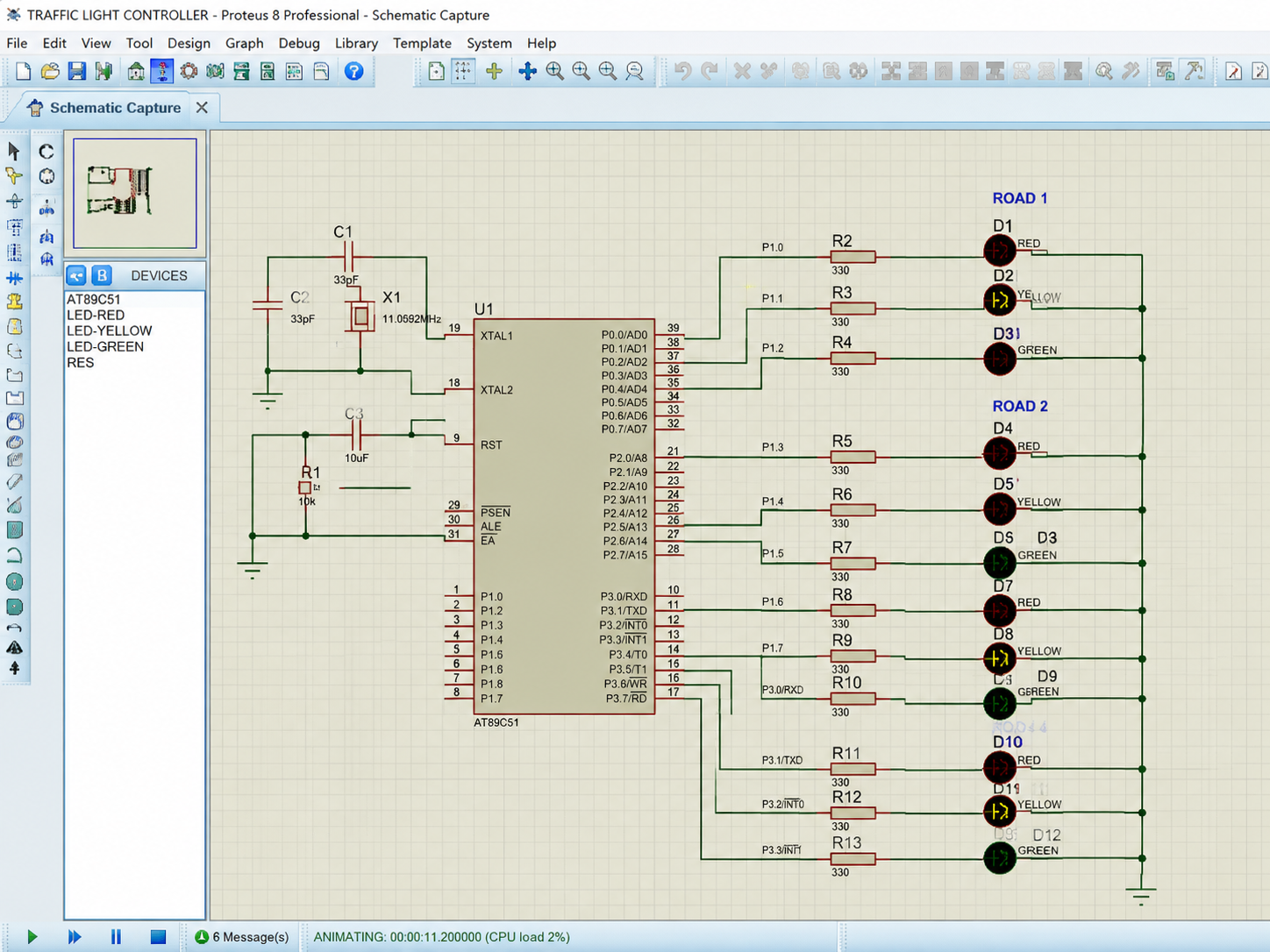
The Traffic Light Controller is a microcontroller-based embedded systems project developed and simulated using Proteus Design Suite. The project demonstrates how programmable controllers can automate traffic signal operations at road intersections, improving traffic flow, reducing congestion, and enhancing road safety. It is designed as an educational and practical project for understanding digital electronics, embedded programming, and traffic signal control systems.
The simulation follows the standard sequence of traffic lights—Red, Yellow, and Green—using predefined timing intervals controlled by a microcontroller. The entire circuit is tested virtually in Proteus before hardware implementation, allowing developers to verify system behavior without physical components.
Project Objectives
- Design an automated traffic light control system.
- Simulate the complete circuit using Proteus.
- Implement sequential traffic signal timing.
- Demonstrate microcontroller programming concepts.
- Improve understanding of embedded systems.
- Reduce manual traffic signal operation.
- Create a scalable foundation for advanced traffic management.
Project Overview
The system controls traffic lights for a four-way intersection by automatically switching between Red, Yellow, and Green signals according to programmed time delays. The microcontroller continuously executes the traffic sequence, ensuring only one direction receives the Green signal at a time while all others remain on Red for safety.
The project is entirely simulated in Proteus, enabling verification of both hardware connections and software logic before physical implementation.
Working Principle
When the simulation starts, the microcontroller initializes all traffic signals. The controller activates the Green light for one direction while the remaining directions stay on Red. After the specified duration, the Green light changes to Yellow for a short warning period before switching to Red. The sequence then repeats for the next traffic lane, ensuring smooth and conflict-free vehicle movement.
This cyclic process continues automatically without manual intervention, accurately representing the operation of real-world traffic signal systems.
Hardware Components
The project utilizes the following components:
- Microcontroller (ATmega328P, PIC, or Arduino-compatible MCU)
- LEDs (Red, Yellow, Green)
- Current Limiting Resistors
- Crystal Oscillator
- Capacitors
- Push Buttons (Optional)
- Power Supply
- Connecting Wires
- Proteus Simulation Environment
Software Requirements
- Proteus Design Suite
- MikroC / MPLAB / Arduino IDE (depending on the controller)
- Embedded C Programming Language
Features
- Automatic traffic signal sequencing.
- Adjustable timing intervals.
- Realistic Proteus simulation.
- Easy-to-understand circuit design.
- Low-cost implementation.
- Modular and expandable architecture.
- Suitable for academic demonstrations.
- Reliable traffic control logic.
Advantages
- Reduces manual traffic management.
- Demonstrates embedded programming concepts.
- Improves understanding of digital control systems.
- Easy to modify and expand.
- Safe virtual testing before hardware implementation.
- Cost-effective educational project.
Applications
The controller can be adapted for:
- Road intersections
- Educational laboratories
- Engineering projects
- Embedded systems training
- Smart city demonstrations
- Traffic management research
Future Improvements
Future enhancements may include:
- Vehicle density detection using sensors.
- Emergency vehicle priority control.
- Pedestrian crossing buttons.
- Countdown timer display.
- IoT-based remote monitoring.
- GSM or Wi-Fi communication.
- AI-based adaptive traffic control.
- Solar-powered traffic signal system.
Learning Outcomes
This project provides practical experience in:
- Embedded Systems
- Microcontroller Programming
- Digital Electronics
- Circuit Design
- Proteus Simulation
- Traffic Signal Logic
- System Testing and Debugging
- Automation Principles
Conclusion
The Traffic Light Controller Using Proteus Simulation successfully demonstrates the implementation of an automated traffic control system using embedded programming and simulation tools. The project provides a strong foundation for learning microcontroller applications and traffic management logic while emphasizing reliability, safety, and efficient signal sequencing. It can serve as a stepping stone toward more advanced intelligent transportation systems incorporating sensors, wireless communication, and adaptive traffic control technologies.